
Colony Construction fabricates and installs bridge crane runways, heavy mezzanines, pipe racks, and custom equipment supports for US mining, oil and gas, and manufacturing facilities. Every component is engineered to AISC 360-22 for the structural member, CMAA 70/74 for crane runway systems, AWS D1.1:2020 for welded joints, and OSHA 29 CFR 1910 for mezzanine guardrails, stair geometry, and fall-protection anchorages. Since 1985 and across 700+ projects, Colony has delivered component scope ranging from 5-ton jib cranes up to 200-ton bridge crane runways – the infrastructure inside industrial buildings that actually carries the process load.
Structural Component Expertise
Colony’s component-fabrication capability covers the infrastructure that turns an industrial building envelope into a working facility: CMAA-compliant bridge crane runways, jib cranes, monorail systems, process mezzanines, equipment support steel, pipe racks, platforms, and walkways. Our engineering team designs to AISC 360-22 for flexural members, CMAA 70 Class A through E duty cycles for crane runway girders, AISC Appendix 3 for fatigue analysis, and ASCE 7 seismic provisions where runway drift and inertial loading govern. Fabrication uses ASTM A992 wide-flange, A572 Grade 50 plate, and AWS D1.1 qualified welding procedures with MT/UT inspection on critical welds.
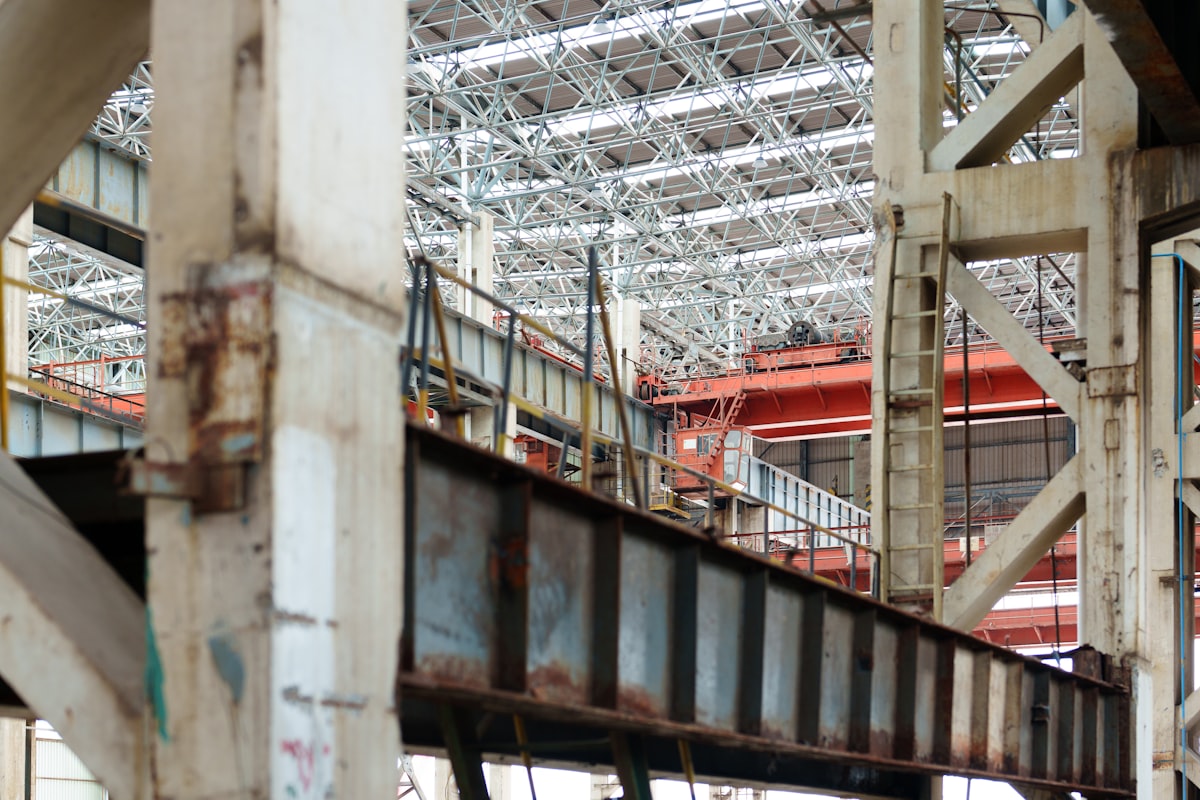
On US mining mill buildings we routinely fabricate 100- and 150-ton bridge crane runways with fatigue-rated girders and seismic-detailed supports. On oil and gas process facilities we build pipe racks carrying 36-inch process piping with combined thermal and wind-load analysis. On manufacturing and distribution buildings we fabricate structural mezzanines up to 500 psf live-load-rated, with OSHA-compliant guardrails, stairs, and fall-protection anchorages built in from day one. Colony also installs – our ironworker crews erect, align, and commission every component we fabricate, so there is no handoff between “who designed it” and “who makes it work in the field.”
Industries We Serve with Structural Components
- Mining Construction – bridge crane runways, conveyor gallery supports, and maintenance-shop jib cranes for Nevada, Utah, and Colorado hard-rock operators.
- Oil & Gas Construction – pipe racks, compressor-station equipment supports, and heavy mezzanines for Permian Basin and Gulf Coast facilities.
- Manufacturing & Warehousing – process mezzanines, equipment platforms, and material-handling crane systems for EV/battery plants and Tier-1 supplier facilities.
- Hydroelectric Construction – powerhouse bridge cranes, intake-gantry supports, and penstock access platforms for Pacific Northwest utilities and Bureau of Reclamation contractors.
- Forestry Construction – mill-floor crane systems, dust-collection mezzanines, and equipment supports for Pacific Northwest and Inland Empire sawmill operators.
Challenges We Solve
CMAA 70/74 Crane Runway Design Through 200+ Tons
Industrial crane runways live under fatigue. Colony engineers runway girders to CMAA Class A through E duty cycles with AISC Appendix 3 fatigue analysis, specifies rails and clamps compatible with the manufacturer’s crane, and details the runway-to-column connections for longitudinal braking force and seismic drift. Our fabrication shops handle the deep sections (W36, W40, built-up plate girders) that 100+ ton cranes require.
OSHA 29 CFR 1910 Compliance on Mezzanines and Platforms
OSHA 1910.28–1910.30 drives mezzanine guardrail height, toeboard dimensions, stair geometry, and fall-protection anchorage requirements. Colony builds these in from detailing – 42-inch top rails, 21-inch mid rails, 4-inch toeboards, 7-inch stair risers, and anchor-point locations pre-engineered into the primary structure. Owners do not inherit a structure that fails OSHA inspection on day one.
Integration Into Existing US Industrial Buildings
Retrofitting a new crane runway or process mezzanine into an existing building requires careful structural analysis of the host frame, often under active-operation constraints. Colony’s engineers analyze the existing structure, design reinforcement where needed, coordinate shutdown windows with plant operations, and sequence installation to minimize production impact – often completing the install over weekend shutdowns or phased nights.
Seismic Detailing for SDC D and E Crane Runways
California, Alaska, and Wasatch Front crane runways require AISC 341 seismic provisions applied to the runway support columns and their connections. Colony details runway-column connections to the special moment frame or braced frame classification, checks drift compatibility with the crane manufacturer’s tolerances, and documents the seismic fuse path for AHJ review.
Equipment Support Structures Under Process Vibration
Mining mills, pulp plants, and chemical facilities install equipment – ball mills, vibrating screens, compressors, pumps – that generates steady-state vibration. Colony analyzes resonance risk, specifies isolation where needed, and designs supports with the stiffness and damping required to prevent fatigue cracking of the structural frame. We have equipment supports in service for 30+ years on mining sites where lighter designs failed in five.
Projects We’ve Delivered

Newmont Red Chris Mine
Heavy crane and equipment support structures for a large copper-gold mining operation. Colony delivered runway girders, mill-equipment supports, and conveyor-gallery steel under integrated CMAA and AISC engineering – representative of the Nevada gold-trend and Utah copper-district component work we target.

Seastar Chemicals
Process-floor mezzanines and equipment supports for a specialty chemical manufacturing facility. Combined OSHA-compliant guardrails, chemical-resistant coatings, and vibration-damped equipment supports – representative of California and Texas Gulf Coast process-component work.

Teck HVC Mantle Rebuild Facility
A crane-integrated maintenance facility for heavy-mining-equipment rebuilds. Colony delivered the bridge crane runway, equipment supports, and mezzanines required to rebuild 400-ton-class haul-truck components – directly applicable to Nevada, Utah, and Colorado mine-maintenance work.
Frequently Asked Questions
What crane capacities can Colony design and fabricate for US industrial sites?
Colony designs and fabricates bridge crane runways from 5-ton jib cranes up to 200+ ton top-running bridge cranes. We handle underhung, top-running, and box-girder crane systems to CMAA 70/74, with AISC Appendix 3 fatigue analysis and seismic detailing per AISC 341 where SDC D or E applies. Individual runway members up to 50 tons are fabricated in-house.
How are mezzanines and equipment platforms engineered for OSHA fall-protection compliance?
Colony designs to OSHA 29 CFR 1910.28–1910.30 from concept – 42-inch top rails, 21-inch mid rails, 4-inch toeboards, compliant stair geometry, and pre-engineered fall-protection anchorage points. Horizontal lifelines and tie-off locations for maintenance access are specified during design, not bolted on later. Live loads are typically specified at 60–125 psf for catwalks and 125–500 psf for heavy equipment platforms.
Can Colony integrate components into an existing US building without a full shutdown?
Yes. We analyze the existing structure, design reinforcement where needed, and sequence install over weekend shutdowns, nighttime hours, or phased area closures. On mining and process plants, we have installed mezzanines and crane runways while the surrounding facility remained in production. The key is integrated engineering and construction planning from day one.
What AISC / CMAA specifications apply to crane runways?
Crane runway girders are designed to AISC 360-22 for flexure and combined loading, AISC Appendix 3 for fatigue, and CMAA Specification 70 or 74 for load factors and duty classification (Class A light through Class F continuous severe). Rail selection follows AISC Design Guide 7. Seismic detailing per AISC 341 applies in SDC D and E jurisdictions.
Start Your Structural Components Project
Send us your scope, schedule, and site details. A Colony estimator will review your project and reply within one business day.